

Beyond Icons: Rethinking Dual Coding in the Primary Classroom
Dual coding isn’t just about removing text and adding pictures. It’s about how we use visuals and space to think more clearly, extend cognition, and construct knowledge.


💡 The Big Idea
Dual coding is often presented as a simple rule: combine words with images to enhance memory and reduce blocks of text to reduce cognitive load. Think: icons next to definitions and vocabulary, diagrams paired with explanations and simplified text in your PowerPoint.
And yes, this helps. Since moving to Panama City to lead an English Curriculum International School, I have very much appreciated icons kindly positioned next to Spanish signs to help me settle into the Latin American world. But stopping at this level of dual coding in the classroom misses something much deeper.
Because dual coding, when reduced to a presentational tips and tricks, loses sight of what it’s really about: how we organise information, offload thinking, and use the space around us to learn more effectively.
It’s not just about adding visuals and reducing blocks of text; it’s about how we arrange, sequence, and interact with information. That means, when we consider dual coding as part of our teaching practice, we should consider much more than the icons we use on a slide or worksheet.
The interactive screen. A mini-whiteboard. A scaffold. A word bank. A timeline. A visualiser. A pupil’s desk. As I argued in A Learning Model Within the Environment, thinking doesn’t happen in isolation. It happens in partnership, not just with others, but with the tools, surfaces, gestures, and layout we use to organise our knowledge. That’s dual coding, too.
👀 A Closer Look
Let’s go back a step. Dual Coding Theory comes from Allan Paivio’s work in the 1970s. He suggested that the brain processes information through two systems: a verbal one and a non-verbal one. So, when pupils both hear an explanation and see a diagram, they encode that knowledge twice, making it more likely to stick.
It’s worth noting: this isn’t the same as working memory models like Baddeley and Hitch’s, which describe short-term processing systems like the phonological loop and visual-spatial sketchpad. But both theories point to the fact that we don’t just think in our heads, we think through images, space, speech, and structure.
Dual coding starts to become more powerful when we consider what might happen when learners start interacting more with the information on the page, around the classroom, on their desks or elsewhere within their environment.
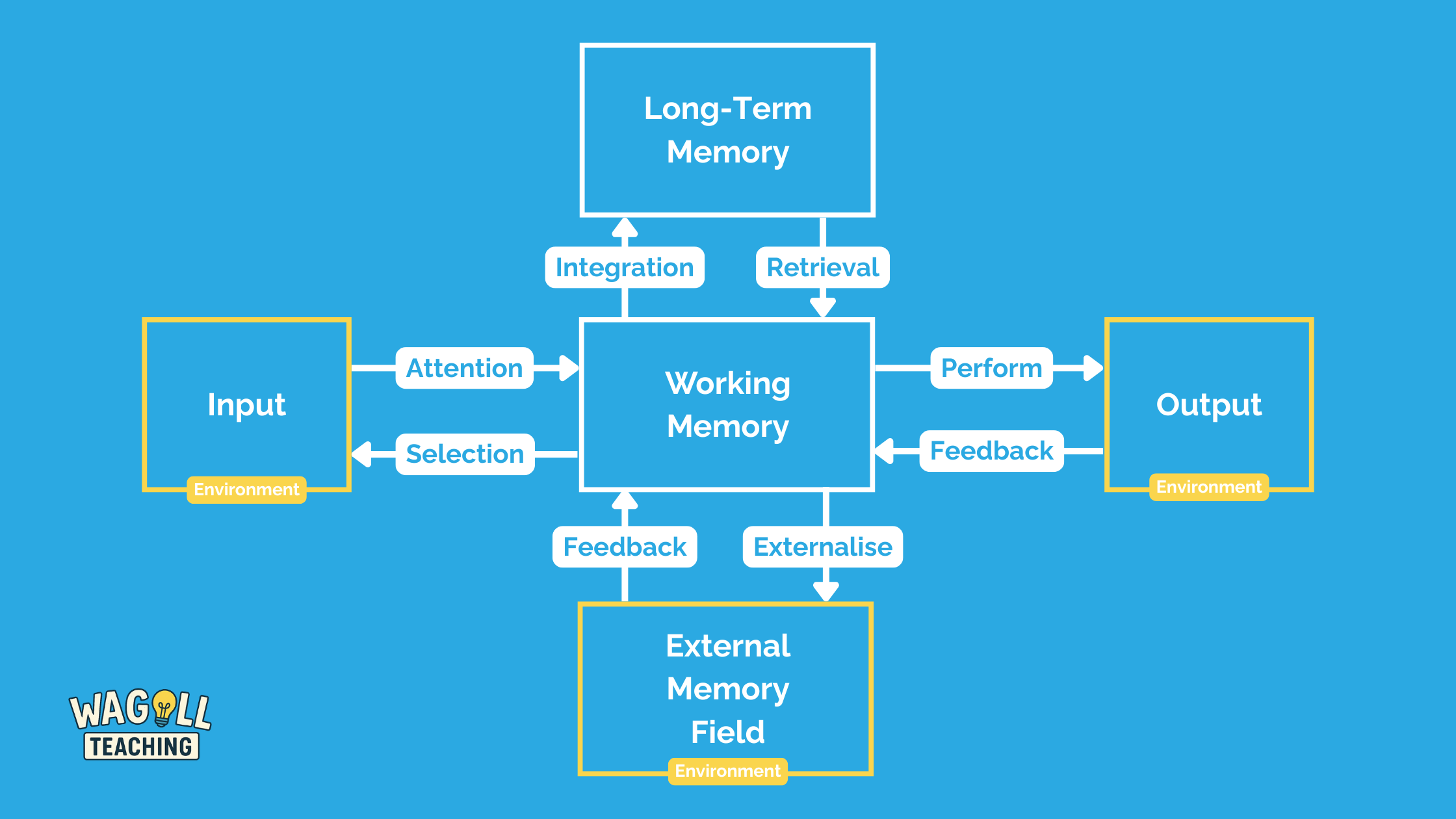
Take manipulatives in maths. Or whiteboard jottings. Or a well-designed writing scaffold. These aren’t just helpful props. They’re ways of externalising and prompting further thought (as highlighted in the learning model above), freeing up working memory and allowing the learner to see, manipulate, and refine what they’re trying to understand.
This again echoes what Merlin Donald called the External Memory Field. These are the diagrams, gestures, notes, tools, and space that we all use to offload our thoughts into the environment.
And yet in schools, we often limit dual coding to slide design. Icons. Simplified symbols. Which are helpful… but not the whole story. So, in Primary, what can we start considering to take Dual Coding to the next level?
Designing for Dual Coding
Dual coding lives in the environment and the task design. It’s not just what teachers present, it’s what pupils do with information within the environment too.
🧱Organising Space to Organise Thinking
How things are arranged for children can be extremely powerful. A list of vocabulary words is useful. But rearrange those words in order of intensity, and suddenly, pupils can see the spectrum. They develop a deeper understanding with very little additional cognitive load.
good, outstanding, fantastic, unbelievable, amazing, super, phenomenal
good → super → fantastic → amazing → outstanding → phenomenal → unbelievable
That’s dual coding. Using spatial layout to reduce effort and improve clarity.
📐 Templates and Scaffolds as Thinking Structures
Graphic organisers, grids, sentence frames, and tables. These are not just supports for weaker learners. They are containers for knowledge. They help pupils group, sort, sequence, and apply ideas.
Take, for example, the classic history timeline. Asking children to write a list of key events helps with sequencing. But, ask the children to sequence events using the template below builds a deeper concept of time between events than a simple list would.
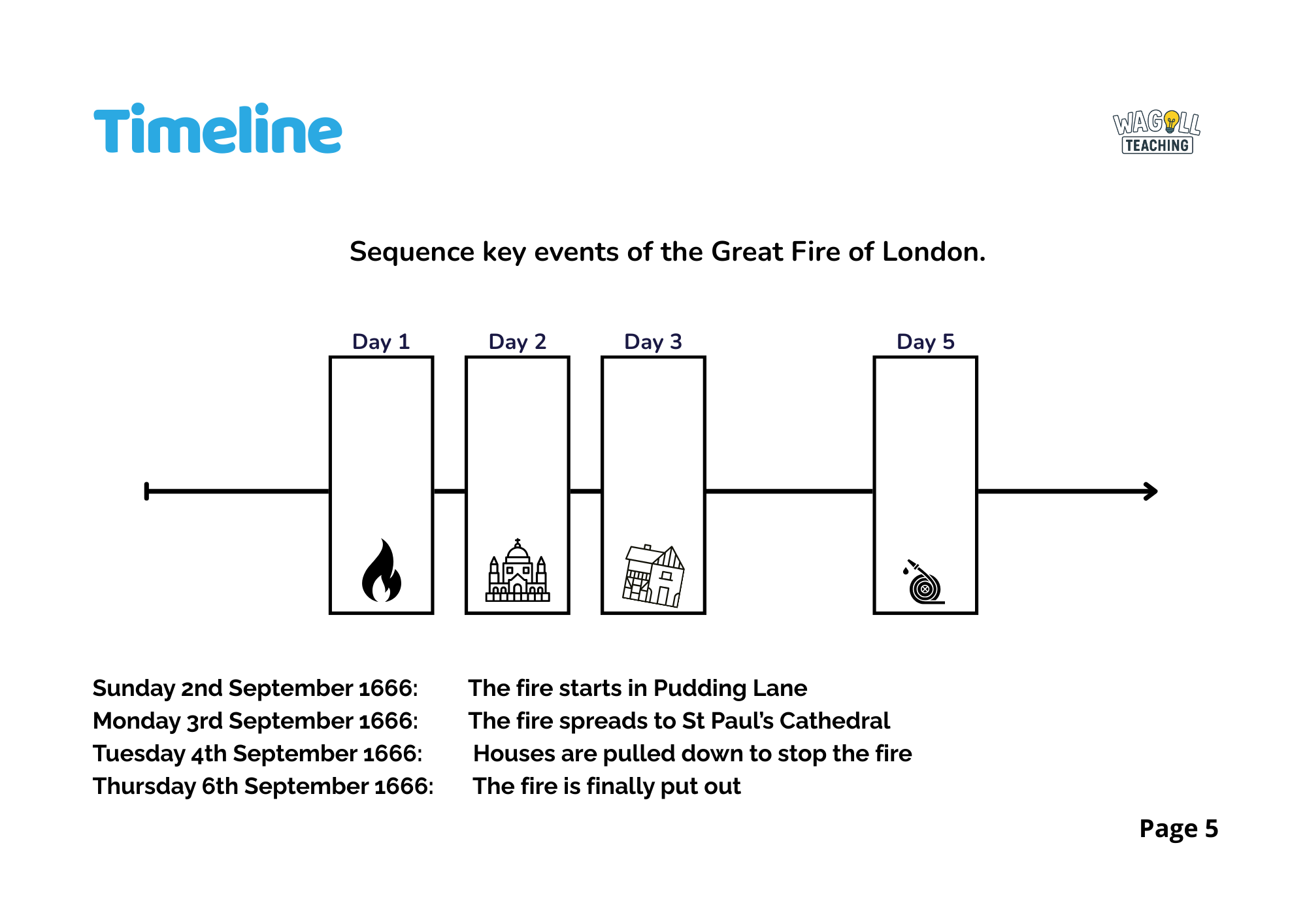
Referring back to my post on Designing Tasks That Help Children Think, when we design tasks that structure thinking, we make the thinking process more visible and provide further opportunities to restructure and deepen knowledge, again with little additional cognitive load.
And other thinking structures, like below, offer children a workspace to connect and build knowledge, not just a worksheet.

🧠 Dual Coding as Metacognitive Practice
When pupils edit their writing by highlighting powerful verbs; when they explain a science experiment using a labelled diagram; when they organise their history knowledge into a timeline, they’re making decisions about how to show their thinking.
That’s metacognition. They are making choices about how to present and represent their thinking.
Even in Early Years, you’ll see it. A child might not yet have the vocabulary for “floating” or “sinking”. But when they push one object under the water and leave another to rest on top, while saying, ´Look, this one does this, but this one does this’, they’re exploring and representing their thinking using the space around them.
And it’s something we should model as teachers. In maths, we already do this instinctively: when we ask pupils to place one digit in each square in their maths book, we’re not being pedantic, we’re helping them organise their understanding of place value to calculate accurately.
But we could do so much more across the curriculum.
Modelling how to organise and manipulate thinking has real value. It’s a habit of experts. A strategy for learners. And a powerful way to link representation with understanding. It’s about teaching children to ask:
What’s the best way to represent this idea?
What layout will help me understand, explain, or apply it?
What tool helps me think more clearly about this?
👐 Gestures and Movement as Knowledge Mappers
When we talk about dual coding, most people picture diagrams, icons, or display slides. But movement, especially gesture, is another powerful, underused form of visual-spatial representation.
As I explored in Gestures: A Primary Classroom Hack for Organising Knowledge, gestures are cognitive tools too. They help teachers and learners externalise thinking, map ideas in space, and support the organisation and understanding of knowledge.
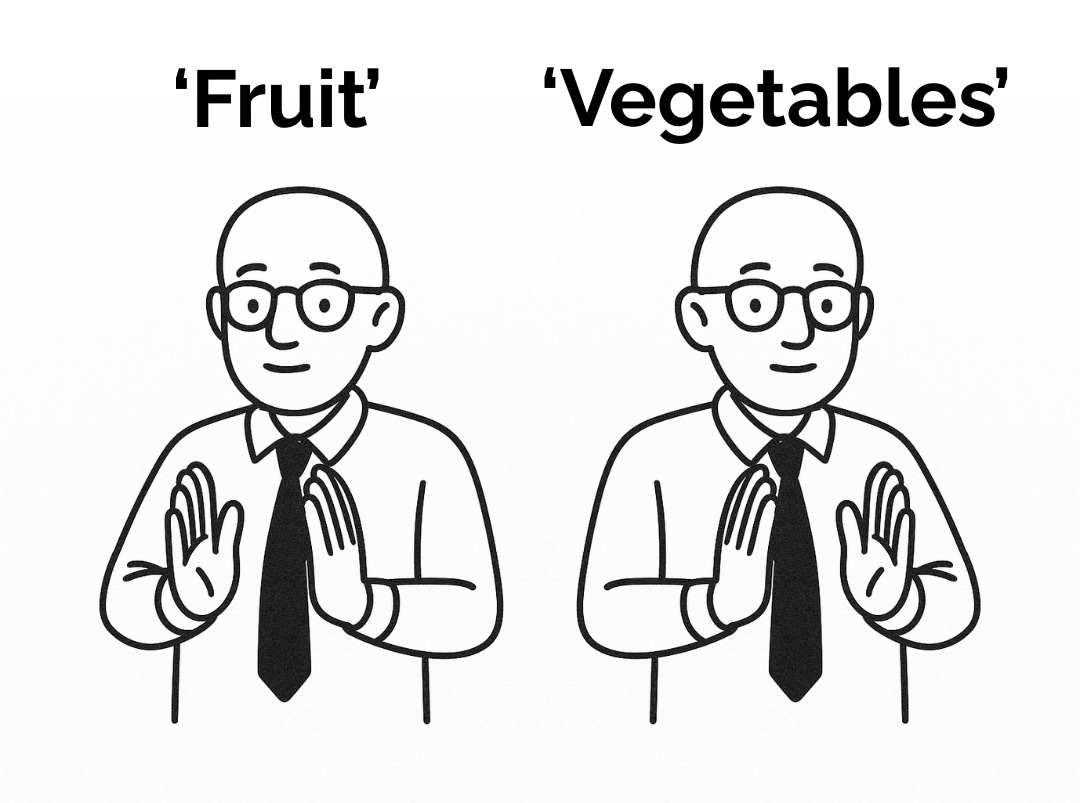
Importantly, gestures aren’t about simplifying learning; they’re about changing the mode through which thinking is communicated and understood.
Take a sequencing example. Instead of saying:
“First we did X, then Y, then at 2pm, we did Z…”
You gesture:
“We did this [step left], this [step again], and this [final step].”
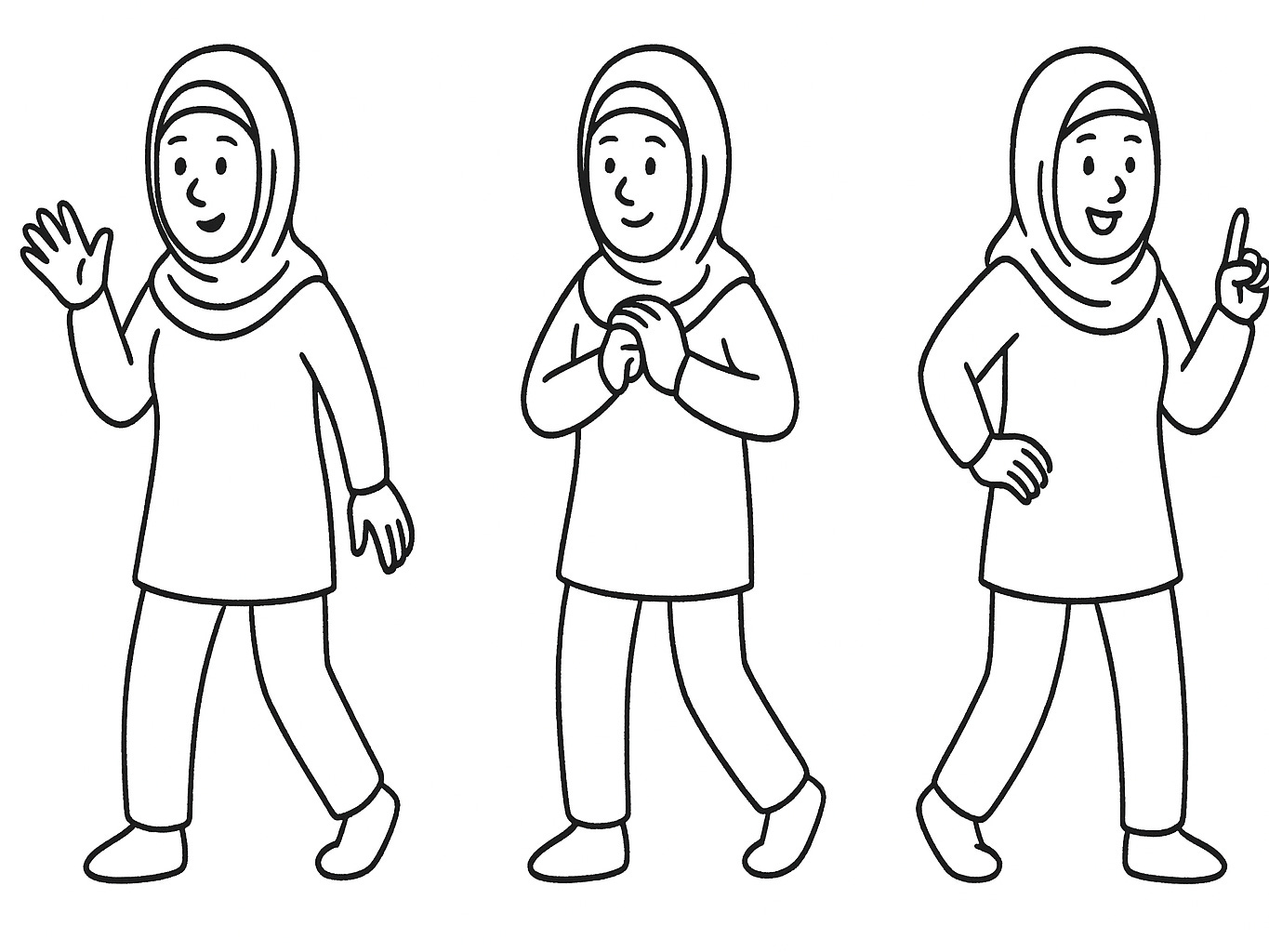
The same depth of information is conveyed, but not all of it is carried through speech. You’ve moved part of the message into physical space, reducing verbal load while retaining complexity.
And so…
That’s my vision. And it goes far beyond icons.
Dual coding isn’t about dumbing things down; it’s about redistributing cognitive demand so that verbal and visual-spatial systems work together. It is not simply about pairing text with pictures. It’s about how learners access, construct, manipulate, and present information.
Whether through diagrams, physical modelling, graphic organisers, or visual routines, we’re teaching children to think in the space around them, to offload, organise, and clarify their thoughts.
(Though, as you can probably tell… I do love an emoji icon or two. 😉)
🎯 The Bits That Stick
✅ Dual coding is more than pictures + words. It’s about how information is arranged, interacted with, and offloaded into the world around us.
✅ Tools like scaffolds, diagrams, and writing frames help organise knowledge and reduce cognitive load.
✅ Dual coding supports all learners, not just as a presentational trick, but as a thinking strategy.
✅ How pupils present their thinking is part of the learning process. And it’s deeply metacognitive.
✅ When we design tasks and environments that promote this, we don’t just help pupils remember. We help them understand.
In a bit,
Coops 😎
📚 References
Paivio, A. (1986). Mental Representations: A Dual Coding Approach.
Donald, M. (1991). Origins of the Modern Mind: Three Stages in the Evolution of Culture and Cognition.
WAGOLL Teaching. (2024). A Learning Model Within the Environment
WAGOLL Teaching. (2024). Designing Tasks That Help Children Think


Hi Ben, This is great. I am really enjoying your work!